


Sea of Cortez facts: the name, Steinbeck, the Cousteau quote and where it meets the Pacific
The Sea of Cortez and Gulf of California are one sea: its two names, the Cousteau quote, Steinbeck's voyage and where it ends.
In this guide
- Sea of Cortez facts at a glance
- A short timeline
- Sea of Cortez vs Gulf of California: why two names?
- How was the Sea of Cortez formed?
- Who called it the aquarium of the world?
- Sea of Cortez and Steinbeck: the 1940 voyage
- Is the Sea of Cortez protected?
- Where does the Sea of Cortez meet the Pacific?
- Seeing the Sea of Cortez from a boat
The Sea of Cortez and the Gulf of California are the same body of water: the sea about 700 miles (1,126 km) long between the Baja California peninsula and mainland Mexico. Gulf of California is the official name. Sea of Cortez honors Hernán Cortés, who sent the first ships to explore it in the 1530s. Its southern limit runs through Land's End in Cabo San Lucas, where it meets the Pacific.
Sea of Cortez facts at a glance
| Fact | Figure |
|---|---|
| Official name | Gulf of California (Golfo de California) |
| Other names | Sea of Cortez, Mar de Cortés, Vermilion Sea (Mar Bermejo) |
| Length | About 700 miles (1,126 km) |
| Width | 30 to 150 miles (48 to 241 km) |
| Age | Began opening about 5 to 6 million years ago |
| Fish species | 891, of which 90 live nowhere else (UNESCO) |
| UNESCO World Heritage | Inscribed 2005; listed as in danger since 2019 |
| Southern limit | Land's End, Cabo San Lucas, to the mainland coast |
A short timeline
| Year | What happened |
|---|---|
| About 5 to 6 million years ago | The peninsula starts to split from the mainland and the gulf opens |
| 1539 | Francisco de Ulloa, sent by Cortés, sails to the head of the gulf |
| 1940 | John Steinbeck and Ed Ricketts collect along its shores for six weeks |
| 1941 | Their book, Sea of Cortez, is published |
| 1951 | Steinbeck's narrative is reissued as The Log from the Sea of Cortez |
| 1973 | The waters at Land's End become an underwater refuge |
| 2005 | UNESCO inscribes 244 islands and coastal areas |
| 2019 | UNESCO adds the property to its in-danger list |
Sea of Cortez vs Gulf of California: why two names?
Because the Spanish named it more than once.
In 1539 Hernán Cortés, the conqueror of central Mexico, sent Francisco de Ulloa north from Acapulco with three ships to find out what lay up the coast. Ulloa sailed to the top of the gulf, reached the mouth of the Colorado River in late September, and came back down the other side. He then rounded Cabo San Lucas and went up the Pacific coast. His voyage showed that Baja California is a peninsula, although maps went on drawing it as an island well into the 1700s.
Two names come out of that voyage. One is Mar Bermejo, the Vermilion Sea, for the reddish water at the mouth of the Colorado. The other is Mar de Cortés, for the man who paid for the ships. Sources disagree on who first used which. Several credit Ulloa with naming it for Cortés, others say he called it Mar Bermejo, and a few local chronologies have Cortés naming it himself in 1535. We would not put a single name and year on it.
Gulf of California came later and is what mapmakers and governments use. In Mexico you will hear both Golfo de California and Mar de Cortés. In Cabo, almost everyone says Sea of Cortez.
How was the Sea of Cortez formed?
It is a young sea. Between about 5 and 6 million years ago the strip of land that is now Baja California began tearing away from the mainland along the boundary between the Pacific and North American plates. The sea flooded the gap. Geologists give dates of 5.3 to 5.5 million years for the opening, and the peninsula is still moving northwest by a few centimeters a year.
The result is long, narrow and deep, with a maximum depth of more than 3,000 meters (9,800 feet). The gulf has 37 major islands and hundreds of smaller ones. The granite of Land's End is far older than the sea around it, which we cover in the Arch of Cabo San Lucas.
Who called it the aquarium of the world?
You will read on almost every Baja travel site that Jacques Cousteau called the Sea of Cortez "the world's aquarium" or "the aquarium of the world." We went looking for where he said it.
Cousteau did work in these waters, and he filmed the sand falls off Land's End. The phrase is credited to him in news articles, conservation campaigns and university teaching material. His son, Jean-Michel Cousteau, has written: "Often called the 'Aquarium of the World' by my father, Jacques Cousteau, the Gulf of California is one of our planet's most extraordinary marine environments."
We could not find a book, a film narration or a dated interview in which Jacques Cousteau says it. None of the many pages that repeat the quote cite one, and the wording changes from page to page. The phrase is attributed to Cousteau, with his family's backing, and nobody seems to have the original.
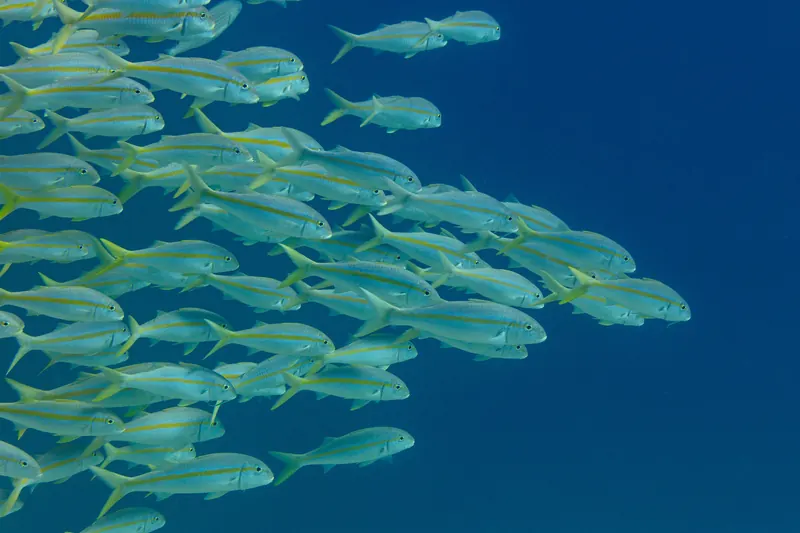
The numbers behind the nickname are easier to source. In its description of the World Heritage site, UNESCO counts 891 species of fish in the gulf, 90 of them found nowhere else. It also says the site holds 39% of the world's species of marine mammals and a third of its cetacean species, the whales and dolphins.
Sea of Cortez and Steinbeck: the 1940 voyage
On March 11, 1940, the novelist John Steinbeck and his friend Ed Ricketts, a marine biologist, left Monterey, California, on a chartered sardine boat called the Western Flyer. Steinbeck's wife, Carol, and a crew of four were aboard. The Grapes of Wrath had been published the year before.
They ran down the Pacific coast, reached Cabo San Lucas on March 17, and spent the following weeks collecting animals from the shore at low tide, up the peninsula side of the gulf and back down the mainland side. They were home on April 20, after six weeks and about 4,000 miles.
The Western Flyer Foundation counts 24 collections from 21 localities and more than 560 species of marine invertebrates. Sources give different numbers for species new to science, from about 40 to about 50.
There are two books, and people mix them up:
- Sea of Cortez: A Leisurely Journal of Travel and Research, by Steinbeck and Ricketts, came out in 1941. It has the narrative of the trip plus a long scientific catalog.
- The Log from the Sea of Cortez came out in 1951. It is the narrative alone, with a memoir Steinbeck wrote about Ricketts, who had died in 1948.
The Cabo San Lucas they found was the cannery village described in our history of Cabo San Lucas.
Is the Sea of Cortez protected?
In part. In 2005 UNESCO inscribed the Islands and Protected Areas of the Gulf of California as a World Heritage site: 244 islands, islets and coastal areas, later extended. Two of the protected areas are close to Cabo. One is the Cabo San Lucas Flora and Fauna Protection Area around Land's End, an underwater refuge since 1973. The other is Cabo Pulmo, the reef on the East Cape described in our Cabo Pulmo article.
On July 3, 2019, the World Heritage Committee put the property on its List of World Heritage in Danger. The reason is the vaquita, a small porpoise that lives only in the far north of the gulf, at the opposite end from Cabo. Vaquitas drown in illegal gillnets set for another endangered animal, the totoaba fish. The IUCN reported that only about 10 remained at the time of the listing, down from almost 300 in 2005.
Where does the Sea of Cortez meet the Pacific?
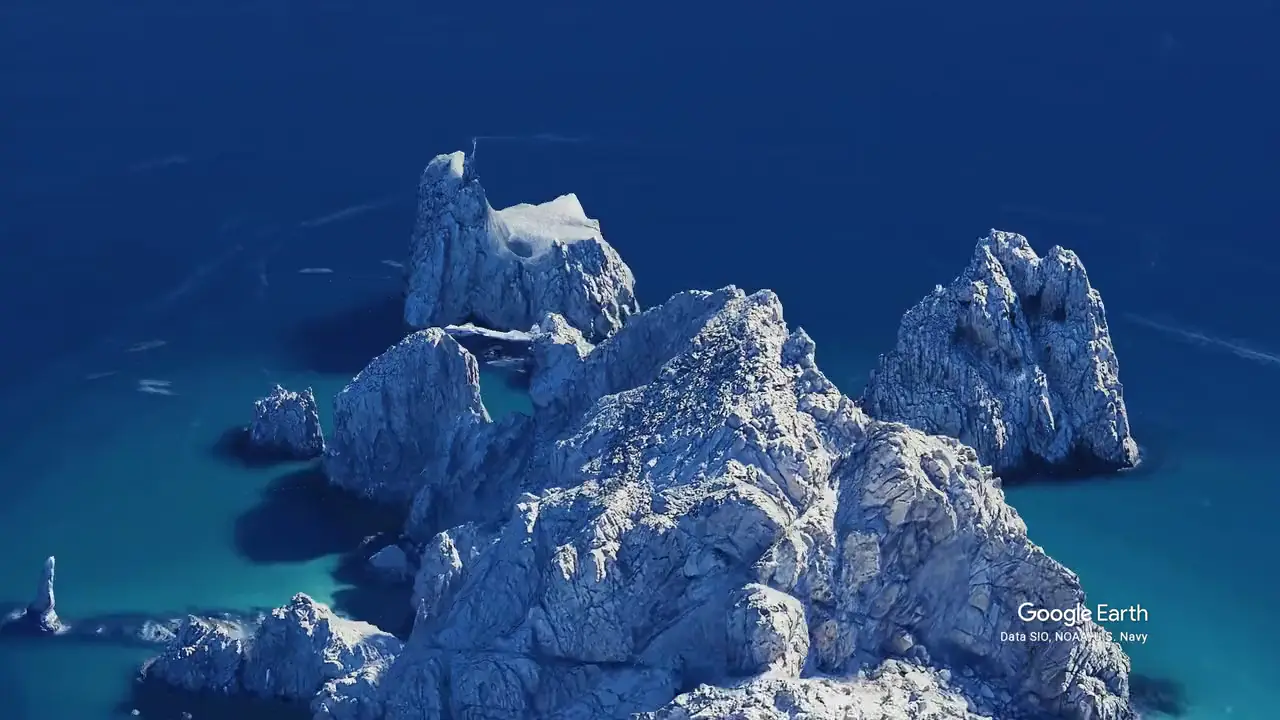
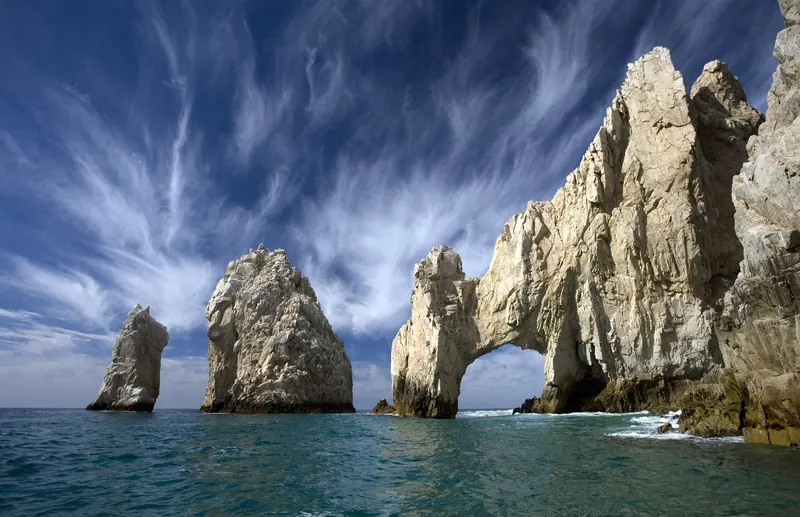
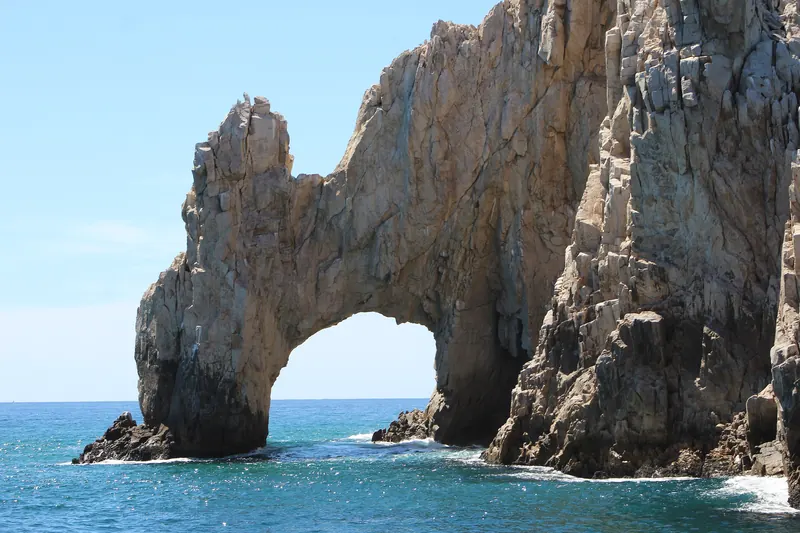
At the end of the rocks in Cabo San Lucas. The International Hydrographic Organization draws the southern limit of the gulf as a line from the southern tip of the peninsula to Piaxtla Point on the mainland. The southern tip is Land's End, and the last piece of it is the Arch.
You can see the difference between the two sides. The bay side is sheltered, with Lover's Beach and the snorkeling at Pelican Rock. Around the corner, Divorce Beach faces open Pacific swell and is not for swimming. Which beaches are which is in Cabo beaches that are safe to swim, and the snorkel spots are ranked in the best snorkeling in Cabo.
Seeing the Sea of Cortez from a boat
Every route we book starts in it. Marina Cabo San Lucas opens onto the bay, and a little over a mile out you are at the line where the two bodies of water meet.
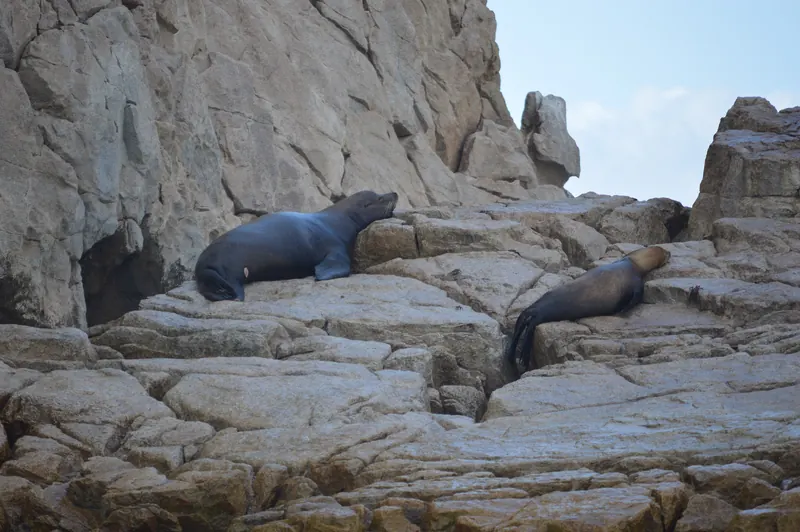
On the 2 hour Arch and Land's End route, the boat passes the sea lion colony and idles off the Arch, 1.2 miles (1.9 km) from the marina. The captain can point out the side that is gulf and the side that is ocean.
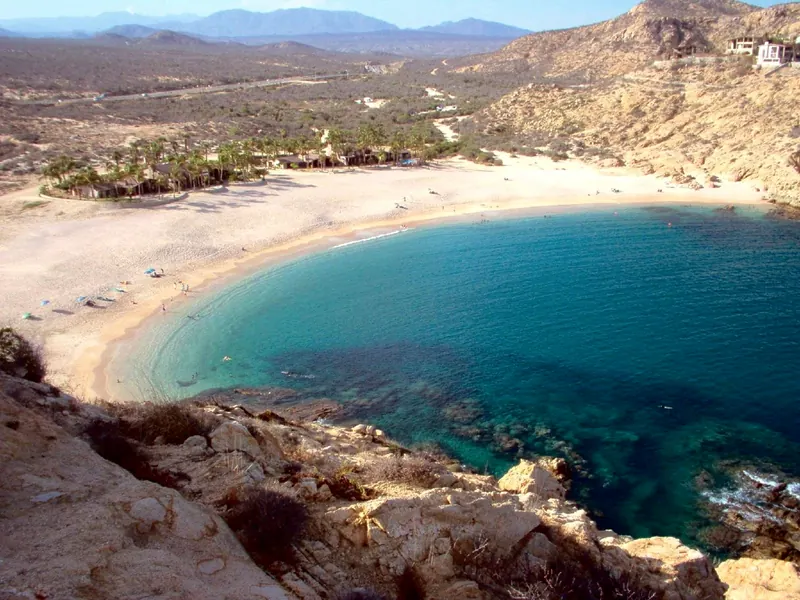
To get in the water, the 4 hour Santa María route goes to the Arch first and then up the gulf coast to Santa María Bay, 6.7 miles (11 km) from the marina, a horseshoe cove with reef along both points. Every yacht includes snorkel gear, and the snorkeling page has what to expect.
On the Sea Ray 40, for up to 12 guests, 4 hours is USD 1,499 (MXN 28,499) and 2 hours is USD 879 (MXN 16,799). Prices are per boat with the 16% tax included. The customary 15% crew tip is not included. You can compare boats and pick a date in the planner.
Yachts in this guide
Questions people ask
Is the Sea of Cortez the same as the Gulf of California?
Yes. Gulf of California is the official name on charts. Sea of Cortez, or Mar de Cortés in Spanish, is the older popular name, after Hernán Cortés. Both mean the sea between the Baja California peninsula and mainland Mexico.
Did Jacques Cousteau call the Sea of Cortez the aquarium of the world?
The phrase is credited to him everywhere, and his son Jean-Michel Cousteau has written that his father often used it. We could not find a book, film or dated interview where Jacques Cousteau says it, so treat it as an attribution, not a sourced quote.
Where does the Sea of Cortez meet the Pacific Ocean?
At Land's End in Cabo San Lucas. The international definition of the gulf draws its southern limit from the southern tip of the Baja peninsula across to Piaxtla Point on the mainland, and that tip is the point of rock that ends at the Arch.
How big is the Sea of Cortez?
About 700 miles (1,126 km) long and between 30 and 150 miles wide. Published figures for its area range from about 160,000 to 177,000 square kilometers, depending on where the mouth is drawn.
Is the Sea of Cortez a UNESCO World Heritage site?
Parts of it are. UNESCO inscribed the Islands and Protected Areas of the Gulf of California in 2005: 244 islands, islets and coastal areas. The property has been on the List of World Heritage in Danger since July 2019 because of the near extinction of the vaquita porpoise.
Plan your day on the water
Pick a yacht, the hours and the food in the planner. A written reply within 2 hours, 8 AM to 8 PM Cabo time.
Keep reading
 Beaches and snorkelingThe Arch Cabo San Lucas: Did It Collapse? How to See ItThe Arch is still standing. How it formed, why sand sometimes appears under it, and the easiest way to see it from the water.7 min readBeaches and snorkelingBest Snorkeling in Cabo: 4 Spots Ranked by EaseWhere to snorkel in Cabo, from Pelican Rock minutes from the dock to Santa María and Chileno up the corridor, with water temperatures by month.7 min read
 Beaches and snorkelingCabo Pulmo National Park: Snorkeling, Diving, the DriveCabo Pulmo is a protected reef about 2 hours from Cabo San Lucas. The drive, the rules, the best months and a closer snorkel option.7 min read
 History and cultureCabo San Lucas Name Meaning and 25 Facts About the CapeWhere the name Cabo San Lucas comes from, plus 25 short, checked facts about the Arch, Land's End, the two seas and the town.8 min read