


Pelican Rock, Cabo San Lucas: the snorkel spot closest to the marina
Cabo's closest snorkel spot, 0.8 miles from the dock: what lives there, the rules, and why a 2 or 3 hour boat is enough.
In this guide
- Where is Pelican Rock in Cabo San Lucas?
- What can you see snorkeling at Pelican Rock?
- The Sand Falls and why the area is protected
- What are the conditions like?
- Rules and safety at Pelican Rock
- Why Pelican Rock fits a 2 or 3 hour boat
- Pelican Rock or Santa María Bay?
- Pelican Rock and Lover's Beach on the same trip
- Booking a Pelican Rock snorkel trip
Pelican Rock is the closest snorkel spot to Marina Cabo San Lucas: a rocky point inside the bay at the foot of Land's End, 0.8 miles (1.3 km) from the dock. The water there is usually calm and clear, and reef fish swim close to the surface. A 2 hour private charter that stops there starts at USD 519 (MXN 9,799) per boat.
It is the first snorkel stop on most charters, and it is the easiest one in Cabo for kids and first-timers.
Where is Pelican Rock in Cabo San Lucas?
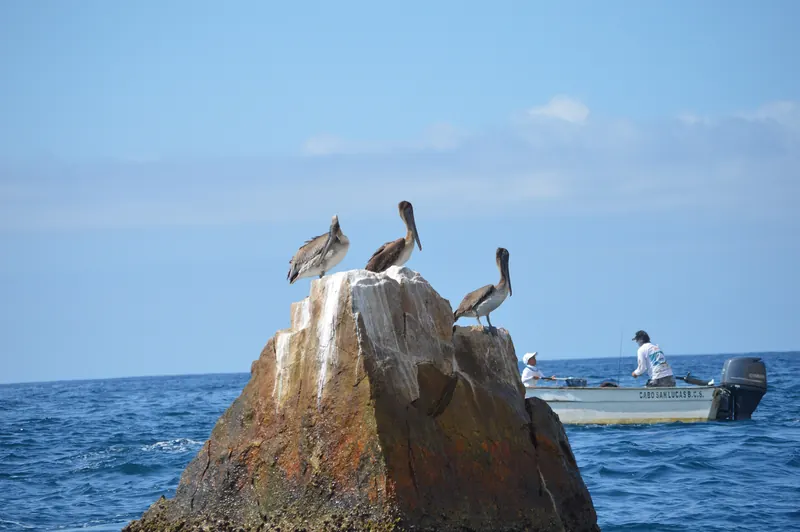
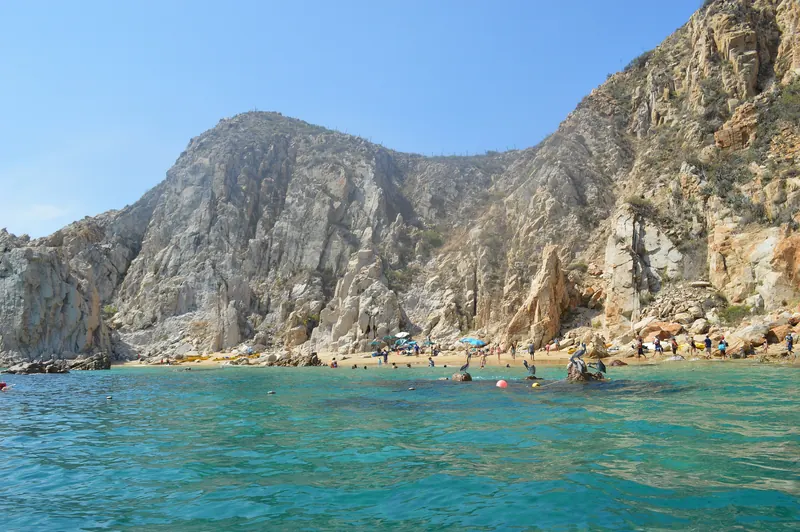
Pelican Rock, Roca del Pelícano in Spanish, sits on the bay side of Land's End, a few minutes by boat from the marina. You reach it by boat only.
On the 2 hour route it comes first: out of the harbor, a stop at Pelican Rock, then Lover's Beach, the Arch and the sea lion colony. Because it's so close, you spend your time in the water instead of on the ride.
The name is literal. Brown pelicans often perch right on top of the rock.
What can you see snorkeling at Pelican Rock?
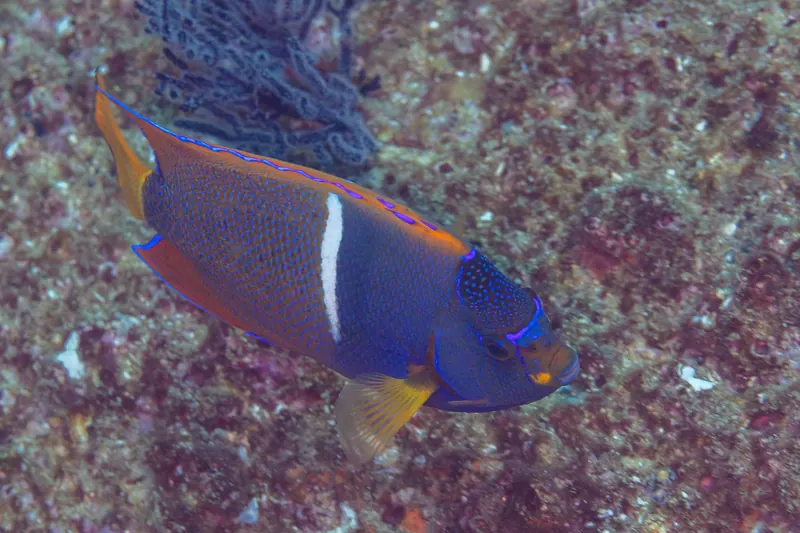
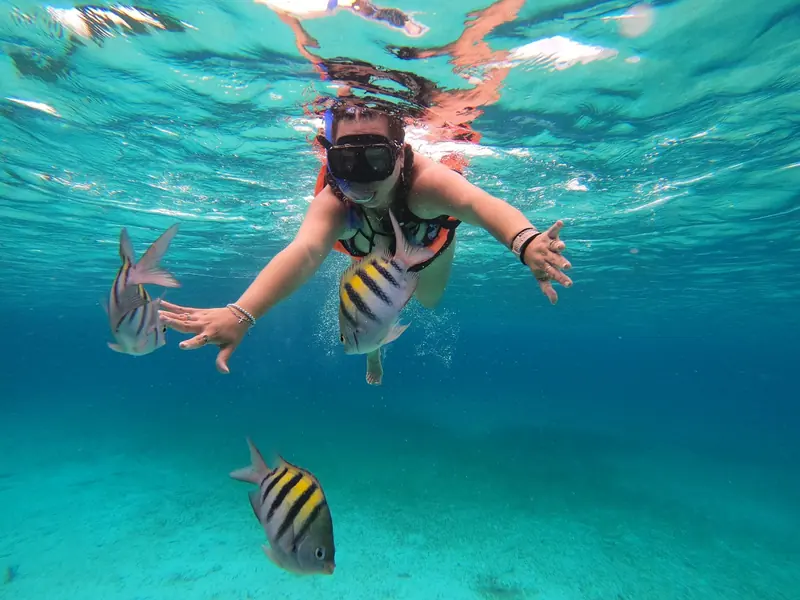
Near the surface you get reef fish in clear water, without having to dive down. Divers who know the site report turtles, moray eels, guitarfish, mobula rays, snapper, jacks, nudibranchs, seahorses and frogfish, and sea lions from the nearby colony pass through. What you see from the surface changes from day to day, so treat that list as possible, not promised.
Below the rock the seabed drops away fast. Past the point it goes beyond 100 ft (30 m), and the Sand Falls pour down below 250 ft (76 m). That is a dive for advanced divers only.
The Sand Falls and why the area is protected
Pelican Rock sits on the stretch of coast where the Sand Falls were found: underwater rivers of sand that spill down rock walls into the San Lucas submarine canyon. A Scripps expedition first saw them in 1959. Robert F. Dill documented them in 1964, and Jacques Cousteau later filmed them. They run for about 800 m (half a mile) along the coast, from Lover's Beach to Playa El Pelícano, the small beach by the rock.
Protecting them is the reason the waters around Land's End became an underwater refuge, by a decree published on November 29, 1973. Today the rock is inside the Cabo San Lucas Flora and Fauna Protection Area: 3,996 ha (about 9,870 acres), 95% of it sea.
That protection comes with a conservation fee. CONANP lists MXN 125 per person per day as of September 2026, with discounts and exemptions, including children under 12. On our charters this fee is already included in the price.
What are the conditions like?
Pelican Rock is inside the bay, which faces the Sea of Cortez and is usually calm. The Pacific side of Land's End, around the point, is another story, with surf and swell.
What changes through the year is the water temperature. These are the 10-year averages from our trip guide:
| Month | Water | Snorkel rating |
|---|---|---|
| January to April | 72°F to 74°F (22°C to 23°C) | Possible |
| May and June | 75°F to 77°F (24°C to 25°C) | Possible to good |
| July | 81°F (27°C) | Best |
| August and September | 85°F (29°C) | Good |
| October and November | 85°F and 81°F (29°C and 27°C) | Best |
| December | 78°F (26°C) | Good |
From January to April, a rash guard or a thin wetsuit top keeps you in the water longer. From July to November most people are fine in a swimsuit.
Go in the morning if you can. The wind usually builds after midday, and calmer water is clearer water.
Rules and safety at Pelican Rock
- Wear the life jacket or snorkel vest your crew hands you. Boats come and go around the rock, and a vest keeps you visible and floating without effort.
- Don't feed the fish. Visitors throw crackers here, and CONANP's draft management program lists feeding marine life as not allowed.
- Don't touch or stand on the rocks and coral underwater.
- Use reef-safe sunscreen.
- Snorkel only where and when your captain says. They pick the spot based on the swell and the traffic that day.
You will probably see people jumping off the rock. Visitor reviews and videos show jumps of about 30 ft (9 m) above the water, with jagged rock below. No official source allows or bans it, and nobody supervises it. If you're tempted, know that it is entirely at your own risk, and check the depth and the swell before you even think about it.
Why Pelican Rock fits a 2 or 3 hour boat
Since it's only 0.8 miles out, Pelican Rock is the snorkel stop that fits a short charter. The 2 hour Arch & Land's End route covers it along with Lover's Beach, the Arch, the sea lions and Divorce Beach, 4.7 miles (7.6 km) round trip. With 3 hours you get the same loop with more time in the water and a longer swim stop on the bay side.
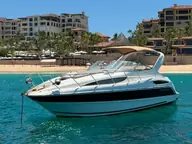
Two boats suit it best for small groups. The Chaparral 28 is a 28 ft sport boat for up to 10 guests, with snorkel gear, a lily pad floating mat, a cooler and a Bluetooth sound system. The Bayliner 33 is a 33 ft express cruiser for up to 8, with ice, bottled water, a floating mat and snorkel gear, and a head (bathroom) on board.
| Yacht | Guests | 2 hours | 3 hours |
|---|---|---|---|
| Chaparral 28 | Up to 10 | USD 519 / MXN 9,799 | USD 709 / MXN 13,599 |
| Bayliner 33 | Up to 8 | USD 599 / MXN 11,399 | USD 869 / MXN 16,599 |
Prices are per boat, not per person, with the 16% tax included. The 15% crew tip is not included. Ten people on the Chaparral 28 for 2 hours pay about USD 52 each. Eight on the Bayliner 33 pay about USD 75 each.
If you need room for more people, the fleet page compares all thirteen yachts, from 6 guests up to 18.
Pelican Rock or Santa María Bay?
The other snorkel spot people ask about is Santa María Bay, a sheltered horseshoe cove up the corridor. It's a better reef. It's also 6.7 miles (11 km) from the marina, so it needs a longer charter.
| Pelican Rock | Santa María Bay | |
|---|---|---|
| From the marina | 0.8 mi / 1.3 km | 6.7 mi / 11 km |
| Charter length | 2 h or more | 4 h or more |
| Best for | Kids, first-timers, short trips | A full snorkel morning |
| From | USD 519 / MXN 9,799 (2 h) | USD 909 / MXN 17,399 (4 h) |
You can do both: the 4 hour snorkel route starts at Pelican Rock and the Arch, then runs up the coast to Santa María. If you're choosing between the coves up the corridor, read Santa María vs Chileno Bay. For every spot ranked from easiest to farthest, see our best snorkeling in Cabo guide.
Pelican Rock and Lover's Beach on the same trip
Lover's Beach is the next stop over, about 1 mile (1.7 km) from the marina on the calm bay side of Land's End. Your crew can drop you close so you swim in to the sand. Pairing the two gives you a snorkel and a beach early in the trip, and the Arch is right around the corner. Our Lover's Beach guide explains which side you can swim on and what to bring.
Booking a Pelican Rock snorkel trip
For a snorkel-focused morning, look at our snorkeling experience, which typically runs 4 hours and adds Santa María. For Pelican Rock alone, 2 hours on the Chaparral 28 or the Bayliner 33 is enough.
Departures run from 7 AM to 7 PM, Cabo time, and an early start gets you the calmest water. Send your date and group size through the planner, and we reply in writing within 2 hours, 8 AM to 8 PM Cabo time. You pay through a secure Stripe link once the date is confirmed.
Yachts in this guide
Questions people ask
How far is Pelican Rock from Marina Cabo San Lucas?
About 0.8 miles (1.3 km), a few minutes by boat. It sits inside the bay at the foot of Land's End, and you can only reach it by water.
What can you see snorkeling at Pelican Rock?
Reef fish swim close to the surface in calm, clear water. Divers also list turtles, moray eels, guitarfish, mobula rays, snapper and jacks, and sea lions pass through, although what shows up near the surface changes day to day.
Is there a fee to snorkel at Pelican Rock?
Pelican Rock is inside a federal protected area. CONANP lists a conservation fee of MXN 125 per person per day as of September 2026, with exemptions such as children under 12. On our charters this fee is already included in the price.
Can you jump off Pelican Rock?
People do, from about 30 ft (9 m), but nobody supervises it and the rock below is jagged. No official source allows or bans it, so it is entirely at your own risk.
How long a boat do you need to snorkel Pelican Rock?
Two hours is enough. The 2 hour Arch & Land's End route includes Pelican Rock, and private charters on it start at USD 519 (MXN 9,799) per boat for up to 10 guests.
Plan your day on the water
Pick a yacht, the hours and the food in the planner. A written reply within 2 hours, 8 AM to 8 PM Cabo time.
Keep reading
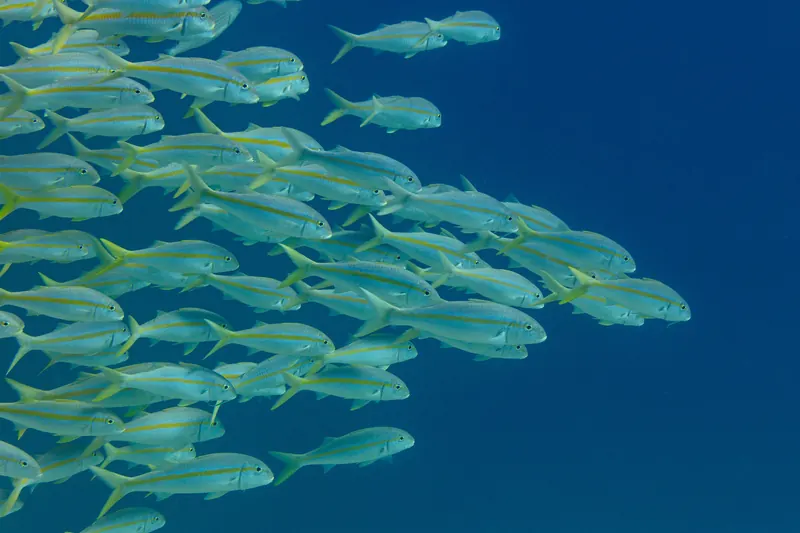 Beaches and snorkelingBest Snorkeling in Cabo: 4 Spots Ranked by EaseWhere to snorkel in Cabo, from Pelican Rock minutes from the dock to Santa María and Chileno up the corridor, with water temperatures by month.7 min read
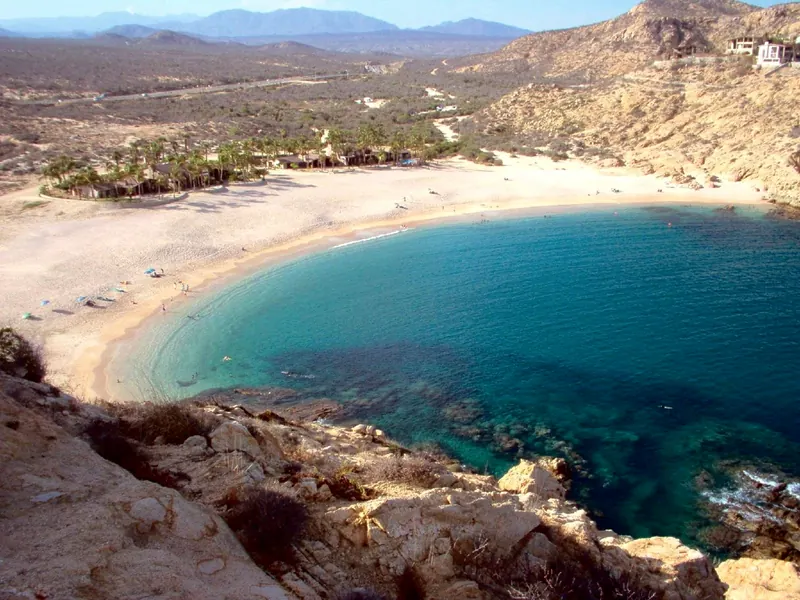 Beaches and snorkelingChileno Bay vs Santa Maria Bay: Which to Snorkel in CaboSanta María or Chileno? How the two corridor coves compare for snorkeling, getting there by car or boat, and doing both in one day.7 min read
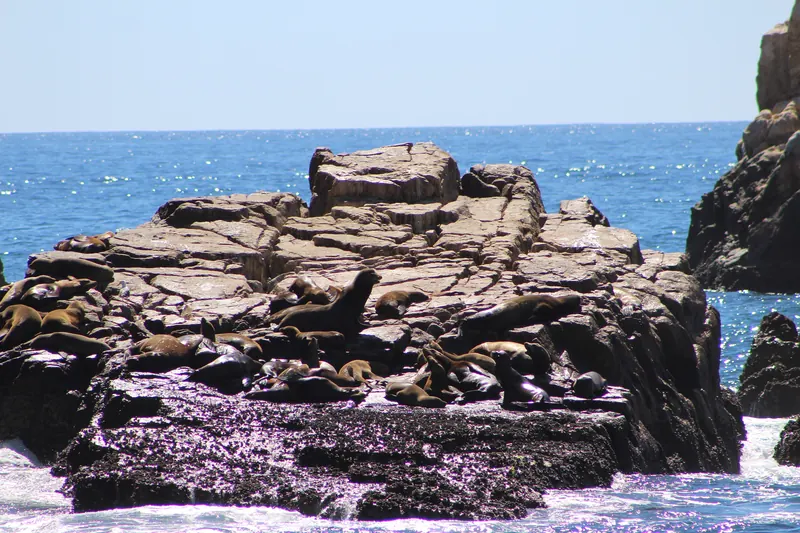 Beaches and snorkelingSea Lions in Cabo: Where the Colony Is and How to See ItWhere Cabo's sea lions haul out, why you watch them from the boat, and which short private routes pass the colony.8 min read
 Plan your tripSnorkeling on a Cabo Cruise Stop: Pelican Rock in 2 HoursMost cruise passengers snorkel Pelican Rock, next to the Arch, in 2 hours. Santa María Bay needs 4. Prices, months, yachts and the all-aboard margin.10 min read